How to Prepare for IELTS at Home Step by Step
- IELTS Tips
- >
- How to Prepare for IELTS at Home Step by Step
- BY Second Author
- IELTS Test
- May 10th 2026
- 6 Mins Read
- 2854
- 0
Preparing for the IELTS exam at home has become one of the most effective ways to improve English skills and achieve a higher band score. With access to quality online resources, structured study plans, and regular IELTS mock test practice, students can now prepare for IELTS without attending physical coaching centers.
Whether you are planning for university admission, immigration, or career opportunities abroad, a smart IELTS preparation strategy can help you achieve your target score faster. Both Academic and General Training candidates can benefit from a well-organized home study routine.
This guide explains how to prepare for IELTS at home step by step using practical strategies, IELTS online course resources, and expert-level preparation techniques.
Understand the IELTS Exam Format First
Before starting your IELTS preparation course, it is important to understand the complete exam structure.
What is IELTS?
IELTS (International English Language Testing System) measures English proficiency for education, immigration, and work purposes. The test is accepted in countries such as the UK, Canada, Australia, and New Zealand ect.
There are two main types of IELTS:
- IELTS Academic preparation (educational purposes)
- IELTS General Training preparation (Work Purpose )
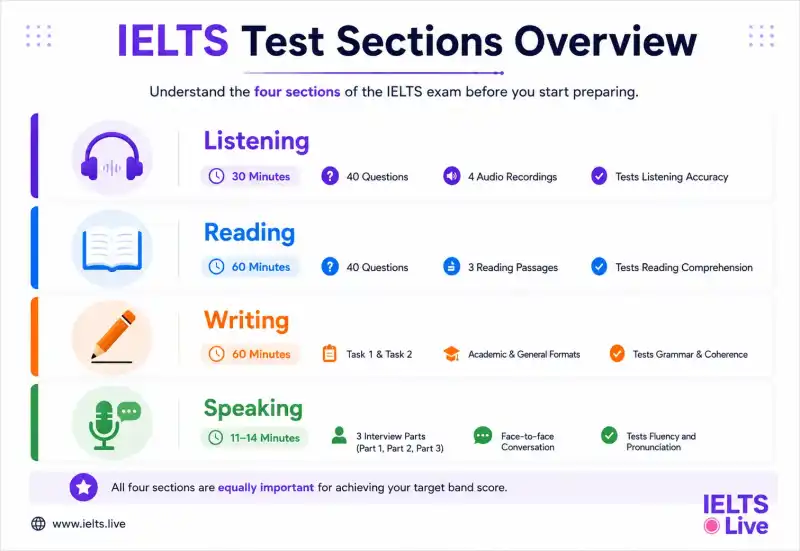
Both versions assess four core skills:
- Listening
- Reading
- Writing
- Speaking
IELTS Band Score System
The IELTS score ranges from Band 0 to Band 9. Most universities and immigration programs require Band 6 to Band 7.5.
IELTS Test Sections Overview
Step 1 – Set Your IELTS Target Score
One of the biggest mistakes students make is studying without a clear goal.
Know Your Required Band Score
Your target score depends on:
- University admission requirements
- Immigration programs
- Scholarship opportunities
- Professional licensing requirements
Create a Realistic IELTS Goal
- Beginners should aim for Band 6 initially
- Intermediate learners can target Band 7+
- Advanced learners may focus on Band 8 strategies
Setting a realistic goal helps create a focused IELTS study plan.
Step 2 – Take a Diagnostic IELTS Mock Test
Starting with an IELTS mock test is essential.
Why Start With a Mock Test?
A mock test helps you:
- Identify strengths and weaknesses
- Understand current performance level
- Build a personalized preparation strategy
Analyze Your Results Carefully
Check:
- Listening mistakes
- Reading accuracy
- Writing grammar and coherence
- Speaking fluency and pronunciation
Regular IELTS practice test analysis improves performance significantly.
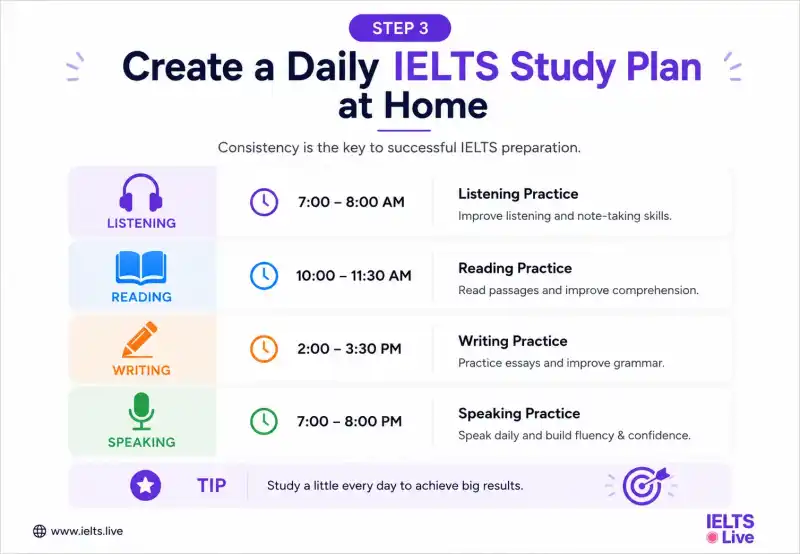
Step 3 – Create a Daily IELTS Study Plan at Home
Consistency is the key to successful IELTS preparation.
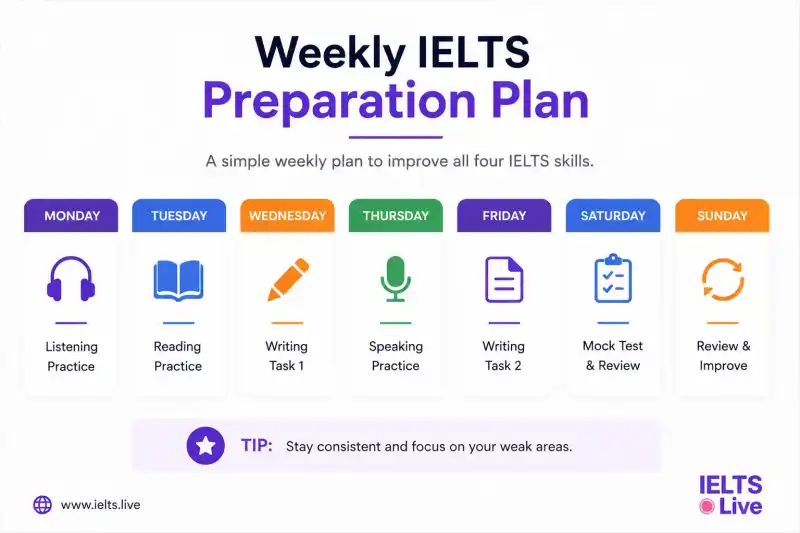
Weekly IELTS Preparation Plan
How Many Hours Should You Study?
- Light preparation: 2 hours daily
- Moderate preparation: 4 hours daily
- Intensive preparation: 6+ hours daily
Choose a schedule based on your current English level and exam deadline.
Step 4 – Gather the Best IELTS Study Materials
Using high-quality resources improves learning efficiency.
Official IELTS Resources
Recommended materials:
- Cambridge IELTS books
- British Council practice resources
- IDP IELTS materials
Best Free IELTS Resources
Good IELTS online platforms provide:
- IELTS online course modules
- Practice tests
- Vocabulary lessons
- Speaking samples
Paid vs Free Resources
- Better study organization
- Expert feedback
- Faster score improvement
- Personalized strategies
Step 5 – Improve IELTS Listening at Home
Many students struggle with concentration and speed during the listening section.
Best IELTS Listening Practice Methods
Practice using:
- Podcasts
- TED Talks
- BBC News
- Official IELTS recordings
Learn Active Listening
Focus on:
- Keywords
- Tone changes
- Numbers and dates
- Synonyms
Improve Listening Score Faster
To improve your IELTS Listening practice:
- Listen daily
- Practice note-taking
- Use headphones regularly
- Review incorrect answers carefully
Consistent listening practice helps improve comprehension naturally.
Step 6 – Improve IELTS Reading Skills at Home
Reading requires speed, accuracy, and vocabulary knowledge.
Learn Skimming and Scanning
These techniques help locate answers faster in long passages.
Improve Reading Speed
To improve IELTS reading practice:
- Read English articles daily
- Use timed reading exercises
- Practice identifying keywords quickly
Build Vocabulary
Focus on:
- Academic vocabulary
- Synonyms
- Topic-based words
Time Management Tips
Do not spend too much time on difficult questions. Move forward and return later if needed.
Step 7 – Prepare for IELTS Writing Step by Step
The writing section is one of the most challenging parts of IELTS.
IELTS Writing Task 1 Overview
Task 1 includes:
- Charts
- Graphs
- Tables
- Processes
- Letters (General Training)
IELTS Writing Task 2 Overview
Task 2 requires essay writing based on an opinion or discussion topic.
Important Essay Types
Learn these structures:
- Opinion Essay
- Discussion Essay
- Problem Solution Essay
- Advantages & Disadvantages Essay
Common Writing Mistakes
Avoid:
- Grammar errors
- Repetition
- Poor coherence
- Weak vocabulary
Improve Writing Score
Strong IELTS writing practice includes:
- Daily essay writing
- Grammar improvement
- Vocabulary expansion
- Expert correction and feedback
Using an IELTS writing correction service can help identify weaknesses faster.
Step 8 – Practice IELTS Speaking at Home
Speaking confidence improves through daily communication practice.
IELTS Speaking Test Format
The speaking test has:
- Part 1: Introduction
- Part 2: Cue Card
- Part 3: Discussion
Improve Fluency and Pronunciation
To improve your IELTS speaking practice:
- Speak English daily
- Record your answers
- Practice common speaking topics
- Focus on natural pronunciation
Common Speaking Mistakes
Avoid:
- Memorized answers
- Long pauses
- Limited vocabulary
- Robotic speaking style
Regular IELTS speaking test practice improves confidence significantly.
Step 9 – Build IELTS Vocabulary Daily
Vocabulary plays a major role in all four IELTS sections.
Important Vocabulary Topics
Focus on:
- Education
- Technology
- Environment
- Health
- Work
- Culture ect
Best Vocabulary Learning Techniques
- Maintain a vocabulary notebook
- Learn collocations
- Practice synonyms
- Use new words in sentences
Strong vocabulary improves:
- Reading comprehension
- Writing quality
- Speaking fluency
Common Mistakes During IELTS Home Preparation
Many students fail to improve because of poor study habits.
Common mistakes include:
- Studying without a plan
- Ignoring weak skills
- Using too many resources
- Skipping speaking practice
- Memorizing answers
- Avoiding mock tests
Avoiding these mistakes can significantly improve your final band score.
Best 30-Day IELTS Home Preparation Strategy
Week 1
Understand IELTS basics and exam format.
Week 2
Focus on skill development and vocabulary.
Week 3
Practice intensive reading, writing, and speaking.
Week 4
Take full IELTS online test simulations and revise weak areas.
FAQs About IELTS Home Preparation
Can I prepare for IELTS at home without coaching?
Yes. Many students successfully prepare using structured self-study plans, IELTS online courses, and regular practice tests.
How many months are enough for IELTS preparation?
Most students need 2–4 months, depending on their English level and target band score.
Is self-study enough for Band 7 in IELTS?
Yes, if you follow a disciplined study routine and practice consistently and give free mock test with ielts.live.
Which IELTS section is hardest?
Many students find IELTS writing task 2and reading part 3 the most difficult because it requires grammar, vocabulary, and idea organization.
Can I prepare for IELTS in 30 days?
Yes, intensive preparation can help improve scores, especially if your English foundation is already strong and you can give free mock text with ielts.live.
Overview
Success in IELTS depends on consistency, smart practice, and proper strategy. Whether you choose self-study or online IELTS coaching, focus equally on Listening, Reading, Writing, and Speaking.
Use official resources, practice daily, analyze mistakes carefully, and take regular IELTS practice tests. With the right approach, preparing for IELTS at home can be highly effective and affordable.
Start your IELTS preparation today and work step by step toward your target band score.
YOU MAY ALSO LIKE
- IELTS Preparation 2023
- Jul 31st 2023
IELTS Test Format

- IELTS Preparation 2023
- Sep 8th 2023
Things to Remember on the IELTS Test Day

- IELTS Preparation 2023
- Nov 30th 2023
IELTS Academic Vs. General Training: What to Choose?

- IELTS Preparation 2023
- Dec 8th 2023
4 Mind-Blowing Reasons to Choose IELTS

- IELTS Preparation 2023
- Mar 8th 2024
A Daily Routine Guide for IELTS Candidates to get band 8
- IELTS Preparation 2023
- May 18th 2026
Best IELTS Online Course for International Students 2026 Guide
IELTS
Live
Live
IELTS Live is a web-based application as part of our integrated online learning environment. It has been made for English learners and IELTS candidates all over the world.